
Back to Blog

    The Cost of Prohibition: A GFN 2026 Panel on Tobacco Harm Reduction and Illicit Trade

    July 14, 2026
    The Cost of Prohibition: A GFN 2026 Panel on Tobacco Harm Reduction and Illicit Trade

    Illicit trade: one pattern across many markets

    GFN, now in its thirteenth year, is the main annual meeting on nicotine science and policy. It brings together researchers, clinicians, consumer advocates, regulators, journalists and industry figures for several days of debate.

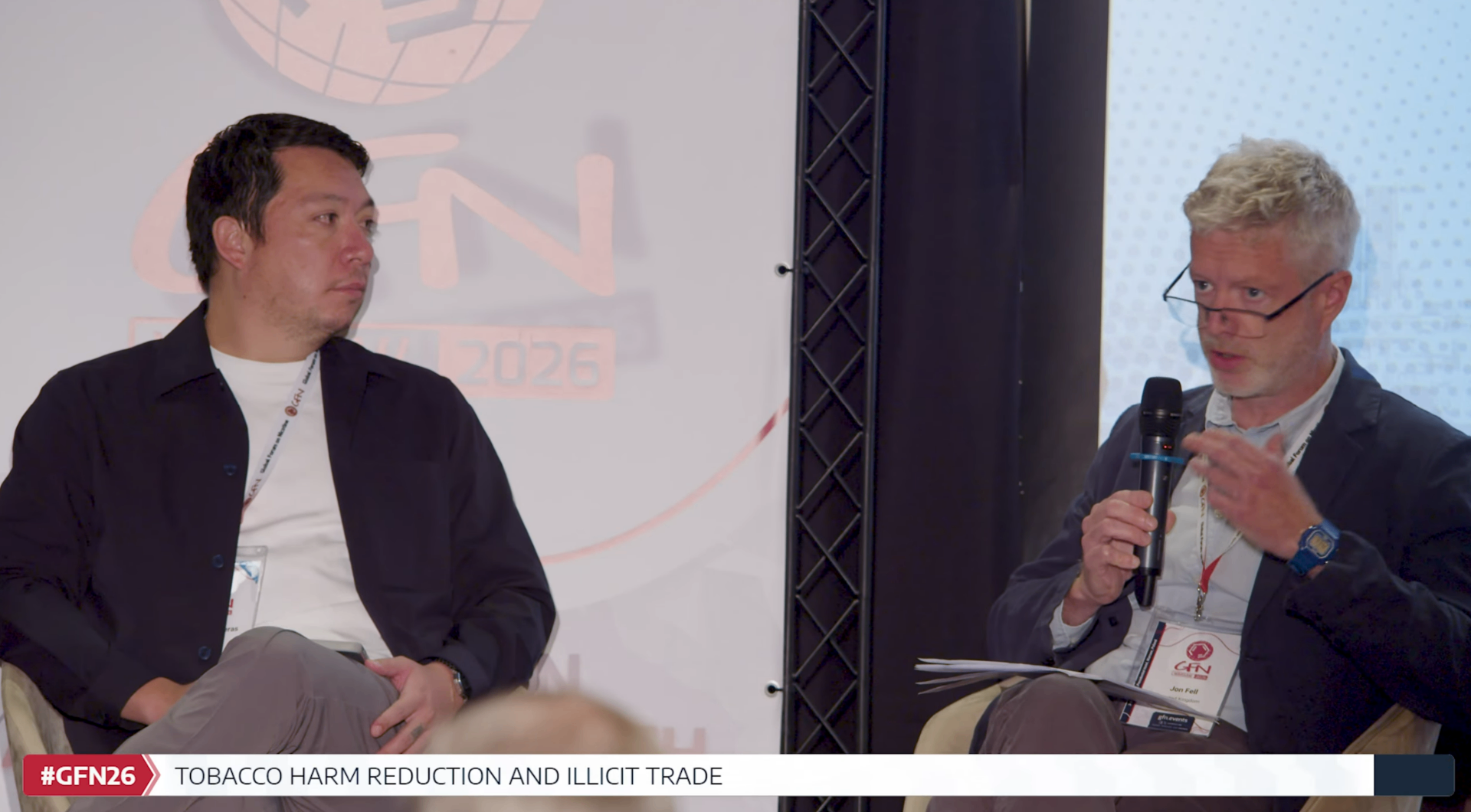
    The Illicit Trade panel was deliberately mixed: Michael Ellis, a former head of INTERPOL's illicit-trade program; Dorrie Heemskerk of the Dutch vaping retailers' association; Asa Saligupta, a Thai consumer advocate; the Mexican organized-crime journalist Oscar Balderas; and Trevor McGaughey of Philip Morris International (PMI). Different rules in each country, but one recurring pattern: restricting the legal market tends to relocate demand rather than remove it.

    The Netherlands provides a very clear example. Ms Heemskerk described how a strict flavor ban (effective January 2024, limiting e-liquids to tobacco flavors with just 16 permitted ingredients) and an earlier ban on online sales have shrunk the legal vaping market by an estimated 75–80%. And Donkere wolken ("Dark clouds"), a report by the agency Bureau Beke commissioned by the Dutch health ministry and published in April 2026, found that 87% of vapers were using banned products or vapes bought through illegal channels. Mr McGaughey noted that PMI's own research finds similar patterns and dynamics in many other markets around the world where the sale of safer nicotine products is prohibited or subject to overly tight regulation.

    Where prohibition meets organized crime

    The harder edge came from markets with outright bans. In Thailand, where import, sale and distribution are illegal, Mr Saligupta described a black market that has migrated to messaging apps and is awash with counterfeits — some containing etomidate, an anesthetic, and other dangerous ingredients. Official data put the number of Thai vapers at 78,000 in 2021; advocates believe the real figure is 2–3m. A parliamentary committee on which Mr Saligupta served reached consensus to regulate and legalize the market, only for the legislation to stall.

    Mr Balderas was bleaker still. Following Mexico's constitutional ban, his investigative work — drawing on interviews with cartel members — estimates that criminal groups now supply effectively the entire market, which he values at roughly 15bn pesos a year. He described vapes used as a currency, to recruit minors and to extort shopkeepers, moving along the same routes as other trafficking, and had hair-raising accounts of the violence committed by the gangs involved in this trade. Mr Ellis set this in a wider frame: in his experience you cannot enforce your way out of illicit trade, because the demand persists and seizures are often simply restocked. Too often politicians take measures which encourage illicit markets to flourish, then pin the blame on enforcement failings.

    Why this matters

    The thread running through every example is simple. Harm reduction only delivers its public-health benefit if people can actually buy the safer product. When a government bans these products, or regulates them so heavily that the legal market collapses, it does not remove the demand — it removes the choice, and with it the consumer's autonomy to move to something less harmful. Supply passes to sellers with no quality control, no age checks and no tax to pay, and the unintended consequences follow in a familiar order: counterfeit and adulterated products, criminal infiltration, people who smoke drifting back to cigarettes, and enforcement agencies left with the fallout. These are the consequences that Professor Etter set out in his keynote address.

    This isn't an unopposed view. Some public-health bodies, the World Health Organization among them, worry most about youth uptake and favor strict enforcement of bans. But across very different markets — the Netherlands, Thailand, Mexico — the panel's picture was strikingly consistent: the benefits prohibition promises rarely materialize, while the harms it creates reliably do. On the evidence of outcomes rather than intentions, the case is for regulating these products in proportion to their risk, not banning them.

    In the end, a ban cannot make the demand disappear. The people the panel kept in view — adults who smoke, reaching for something safer — will find a seller whatever the law says. The only thing prohibition decides is whether that seller is a licensed retailer or a criminal.

    A video of GFN's Illicit Trade panel is available here.

    An investor should consider the investment objectives, risks, and charges and expenses of the fund carefully before investing. A prospectus which contains this and other information about the fund may be obtained by calling 1-800-617-0004, or by clicking here. The prospectus should be read carefully before investing.

    Investing involves risk. Principal loss is possible. The Fund is a recently organized entity, giving prospective investors a limited track record on which to base their investment decision. The Fund’s investments will be concentrated in the securities of issuers in the tobacco, or nicotine-related group of industries. The tobacco industry is subject to significant risks and uncertainties that could materially and adversely affect the financial condition and cash flows, of companies operating in it. Investing in foreign securities typically involves more risks than investing in U.S. securities, and includes risks associated with: (i) internal and external political and economic developments – e.g., the political, economic and social policies and structures of some foreign countries may be less stable and more volatile than those in the U.S. or some foreign countries may be subject to trading restrictions or economic sanctions; (ii) trading practices – e.g., government supervision and regulation of foreign securities and currency markets, trading systems and brokers may be less than in the U.S.; (iii) availability of information – e.g., foreign issuers may not be subject to the same disclosure, accounting and financial reporting standards and practices as U.S. issuers; (iv) limited markets – e.g., the securities of certain foreign issuers may be less liquid (harder to sell) and more volatile; and (v) currency exchange rate fluctuations and policies. Investment in emerging market securities involves greater risk than that associated with investment in securities of issuers in developed foreign countries.

    Derivatives may pose risks in addition to and greater than those associated with investing directly in securities, currencies or other investments, including risks relating to leverage, imperfect correlations with underlying investments or the Fund’s other portfolio holdings, high price volatility, lack of availability, counterparty credit, liquidity, valuation and legal restrictions. A total return swap is a contract in which one party agrees to make periodic payments to another party based on the change in market value of the assets underlying the contract, which may include a specified security, basket of securities, or securities indices during the specified period, in return for periodic payments based on a fixed or variable interest rate or the total return from other underlying assets. The Fund is a non-diversified, investment company under the 1940 Act. Because the Fund is non-diversified, it will invest a greater percentage of its assets in the securities of a limited number of issuers. Investing in medium and small capitalization companies may involve special risks because those companies may have narrower product lines, more limited financial resources, fewer experienced managers, dependence on a few key employees, and a more limited trading market for their stocks, as compared with larger companies. The securities of micro-cap companies may be more volatile in price, have wider spreads between their bid and ask prices, and have significantly lower trading volumes than the securities of larger capitalization companies.

    ETFs are subject to risks that the market price of an ETF's shares may trade at a premium or discount to its net asset value, an active secondary trading market may not develop or be maintained, or trading may be halted by the exchange in which they trade, which may impact an ETF's ability to sell its shares. Shares of any ETF are bought and sold at market price (not NAV) and are not individually redeemed from the ETF. Brokerage commissions will reduce returns.

    The Hexis Nicotine Transition Score (HNTS) is a proprietary framework reflecting the manager’s subjective assessments; independent review by ACA Ethos is not an endorsement of the Fund.

    ETF holdings are subject to change and are not recommendations to buy or sell any security. For current holdings, please click here: Hexis Capital Management | <NICO>

    The Hexis Active Nicotine Engagement ETF is distributed by Quasar Distributors, LLC

    Definitions used on these pages:

    R&D: Research and development spend – investment in developing new products, technologies, or capabilities.

    M&A: Mergers and acquisitions spend – spending on acquiring or merging with other companies to expand scale, capabilities, or market access.

    Capex: Capital expenditure – investment in long-term physical or intangible assets such as facilities, equipment, or infrastructure.

    Discounted Cash Flow (DCF) model – a valuation method that estimates a company’s value by discounting its expected future cash flows back to today.

    Terminal value – the estimated value of a business beyond the explicit forecast period in a DCF model.

    Terminal growth rate – the assumed long-term, steady growth rate used to calculate terminal value.

    EV: Enterprise Value – a measure of a company’s total value, calculated as market capitalisation plus net debt.

    EBITDA: Earnings before interest, taxes, depreciation and amortisation.