
Back to Blog

    Nicotine 2030: A Considered Case for Industry Transformation

    July 6, 2026
    Nicotine 2030: A Considered Case for Industry Transformation

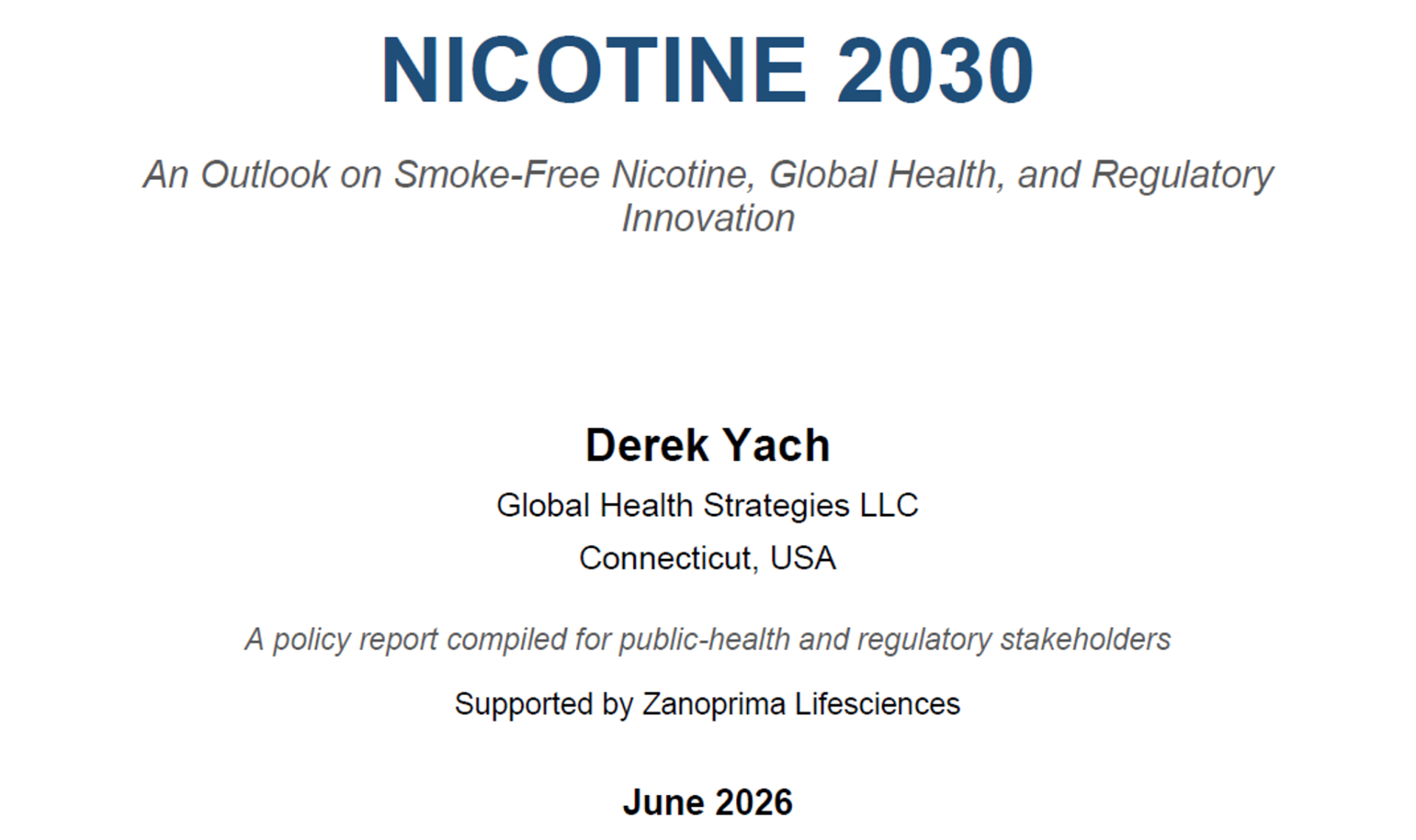
    Dr Derek Yach’s Nicotine 2030, published earlier this month in conjunction with Zanoprima Lifesciences, a developer of synthetic nicotine, pulls together much of the evidence that has built up in recent years on smoke-free nicotine, global health and regulation. We read it with particular interest because Dr Yach chairs our Harm Reduction Stewardship Council and writes with real standing in this field: as a former Executive Director at the World Health Organization, he played a leading role in developing the Framework Convention on Tobacco Control, still the foundation of global tobacco policy.

    The central finding is striking: if 20% of the world’s roughly one billion smokers were to switch to verified low-risk nicotine products within fifteen years, Dr Yach’s modelling suggests around 100m premature deaths could be averted by 2060 — on top of the gains from conventional tobacco control. The figure is an estimate, not a forecast, and the report is open about its assumptions. But the direction fits our own view: that the transformation of this industry is a major opportunity for global public health and, handled responsibly, for investors too.

    The evidence has moved; policy has been slower

    The scientific evidence in favour of tobacco harm reduction continues to build. The report notes that smoke-free products expose users to dramatically lower levels of harmful chemicals than cigarettes – in many cases a small fraction of those found in smoke – and that recent Cochrane and Addiction reviews find consistent evidence of e-cigarettes outperforming traditional nicotine-replacement therapy for cessation. As Dr Yach puts it, ‘the enemy is smoke, not nicotine’.

    But regulation has often gone the other way. Across several of the largest markets the instinct has been to restrict rather than to regulate in proportion to risk — and prohibition has a habit of redirecting demand rather than removing it, often toward something worse. India is the clearest example: its 2019 ban on e-cigarettes closed off a lower-risk option while consumption of gutkha — a hazardous smokeless tobacco product strongly linked to oral cancer — rose sharply, with rural household use rising more than fivefold between 2011–12 and 2023–24. Bans rarely remove demand; more often they push it into unregulated channels, with no quality control, no youth protection and no tax revenue.

    The contrast between markets

    The report draws weight from the divergence between markets that have made room for harm reduction and those that haven’t. Dr Yach points to Sweden, where decades of snus and more recent nicotine-pouch use accompanied a fall in adult daily smoking below 5%; to Japan, where rapid uptake of heated tobacco coincided with a 52% decline in cigarette sales between 2014 and 2023; and to the United Kingdom, where over 2m ex-smokers had switched to vaping by 2024. These are population-level observations rather than controlled experiments, but taken together they are hard to dismiss.

    Why this matters for investors — and why policy is the missing piece

    At Hexis we favour investors engaging with industry rather than divesting, and the report reinforces why. It describes an industry already some way into transformation: certain companies have taken big strides, with smoke-free products now a substantial and growing share of their revenues, while others lag well behind. That gap is exactly where engaged, long-term shareholders can have some influence — pressing for capital to flow toward reduced-risk products, for credible targets, and for open and transparent discussion of progress and challenges.

    But companies can only do so much on their own. The most important point in the report is that the health benefits of transformation will only be fully realised if governments put the right policies in place. Risk-proportionate regulation — quality standards instead of bans, and taxation that tracks the wide differences in risk between combustible and reduced-risk products — is what lets people who smoke move toward legally-available less harmful products rather than stick to cigarettes or turn to illicit markets. The report is encouraging here too: bodies such as the IMF and the reinsurer Swiss Re have started to reflect the risk continuum in how they think about taxation and the underwriting of smoking risk.

    Conclusions

    Nicotine 2030 won’t settle a debate that remains, as Dr Yach acknowledges, as much about ideology as science, and it shouldn’t be read as a guarantee of any outcome. What it does is set out the case that the means to avert a large share of the world’s smoking deaths already exist, and that the main barriers now are political rather than scientific. For investors willing to engage rather than walk away, and for governments willing to regulate in proportion to risk, that is an opportunity worth taking seriously.

    An investor should consider the investment objectives, risks, and charges and expenses of the fund carefully before investing. A prospectus which contains this and other information about the fund may be obtained by calling 1-800-617-0004, or by clicking here. The prospectus should be read carefully before investing.

    Investing involves risk. Principal loss is possible. The Fund is a recently organized entity, giving prospective investors a limited track record on which to base their investment decision. The Fund’s investments will be concentrated in the securities of issuers in the tobacco, or nicotine-related group of industries. The tobacco industry is subject to significant risks and uncertainties that could materially and adversely affect the financial condition and cash flows, of companies operating in it. Investing in foreign securities typically involves more risks than investing in U.S. securities, and includes risks associated with: (i) internal and external political and economic developments – e.g., the political, economic and social policies and structures of some foreign countries may be less stable and more volatile than those in the U.S. or some foreign countries may be subject to trading restrictions or economic sanctions; (ii) trading practices – e.g., government supervision and regulation of foreign securities and currency markets, trading systems and brokers may be less than in the U.S.; (iii) availability of information – e.g., foreign issuers may not be subject to the same disclosure, accounting and financial reporting standards and practices as U.S. issuers; (iv) limited markets – e.g., the securities of certain foreign issuers may be less liquid (harder to sell) and more volatile; and (v) currency exchange rate fluctuations and policies. Investment in emerging market securities involves greater risk than that associated with investment in securities of issuers in developed foreign countries.

    Derivatives may pose risks in addition to and greater than those associated with investing directly in securities, currencies or other investments, including risks relating to leverage, imperfect correlations with underlying investments or the Fund’s other portfolio holdings, high price volatility, lack of availability, counterparty credit, liquidity, valuation and legal restrictions. A total return swap is a contract in which one party agrees to make periodic payments to another party based on the change in market value of the assets underlying the contract, which may include a specified security, basket of securities, or securities indices during the specified period, in return for periodic payments based on a fixed or variable interest rate or the total return from other underlying assets. The Fund is a non-diversified, investment company under the 1940 Act. Because the Fund is non-diversified, it will invest a greater percentage of its assets in the securities of a limited number of issuers. Investing in medium and small capitalization companies may involve special risks because those companies may have narrower product lines, more limited financial resources, fewer experienced managers, dependence on a few key employees, and a more limited trading market for their stocks, as compared with larger companies. The securities of micro-cap companies may be more volatile in price, have wider spreads between their bid and ask prices, and have significantly lower trading volumes than the securities of larger capitalization companies.

    ETFs are subject to risks that the market price of an ETF's shares may trade at a premium or discount to its net asset value, an active secondary trading market may not develop or be maintained, or trading may be halted by the exchange in which they trade, which may impact an ETF's ability to sell its shares. Shares of any ETF are bought and sold at market price (not NAV) and are not individually redeemed from the ETF. Brokerage commissions will reduce returns.

    The Hexis Nicotine Transition Score (HNTS) is a proprietary framework reflecting the manager’s subjective assessments; independent review by ACA Ethos is not an endorsement of the Fund.

    ETF holdings are subject to change and are not recommendations to buy or sell any security. For current holdings, please click here: Hexis Capital Management | <NICO>

    The Hexis Active Nicotine Engagement ETF is distributed by Quasar Distributors, LLC

    Definitions used on these pages:

    R&D: Research and development spend – investment in developing new products, technologies, or capabilities.

    M&A: Mergers and acquisitions spend – spending on acquiring or merging with other companies to expand scale, capabilities, or market access.

    Capex: Capital expenditure – investment in long-term physical or intangible assets such as facilities, equipment, or infrastructure.

    Discounted Cash Flow (DCF) model – a valuation method that estimates a company’s value by discounting its expected future cash flows back to today.

    Terminal value – the estimated value of a business beyond the explicit forecast period in a DCF model.

    Terminal growth rate – the assumed long-term, steady growth rate used to calculate terminal value.

    EV: Enterprise Value – a measure of a company’s total value, calculated as market capitalisation plus net debt.

    EBITDA: Earnings before interest, taxes, depreciation and amortisation.