Although tobacco harm reduction (THR) products have only been available in most markets for a relatively short time compared to cigarettes, the evidence that they are effective in helping to reduce smoking rates is growing.
Cochrane Review of E-Cigarettes
Cochrane Reviews are considered the gold standard for evidence synthesis in health and medicine. They systematically search all research on a question, assess study quality transparently, and publish regular updates as new evidence emerges.
The November 2025 review found:
- People using nicotine e-cigarettes are more likely to quit smoking for at least six months than those using traditional nicotine replacement therapies (NRTs) like patches or gum.
- This demonstrates a clinically important benefit of e-cigarettes, with implications for policymakers, clinicians, and people who smoke.
Lower Smoking, Lower Risk: The Promise of THR
Real-world data shows that THR products significantly help reduce smoking rates, offering effective harm reduction solutions for populations worldwide.
There are now quite a few markets in which the widespread availability of THR products appears strongly linked to steep declines in smoking rates. Here are some examples:
THR Use in the United Kingdom
A 2025 study based on data from the Smoking Toolkit Study found that in 2023-24, in a sample of over 25,000 consumers in England, e-cigarettes were the aid most commonly used in attempts to quit smoking (used in 40% of quit attempts, compared to over-the-counter NRT in 17% of attempts, and 41% of quit attempts occurring unaided).
The study authors found that those using e-cigarettes were 1.95x more likely to successfully quit cigarettes than those trying to quit unaided. Those using NRT were essentially no more likely to be successful in quitting than those making the attempt unaided.
According to the UK’s Office for National Statistics, the proportion of those aged 16 or over in the UK using e-cigarettes daily or occasionally in Great Britain overtook current smokers for the first time in 2024.
Current e-cigarette users
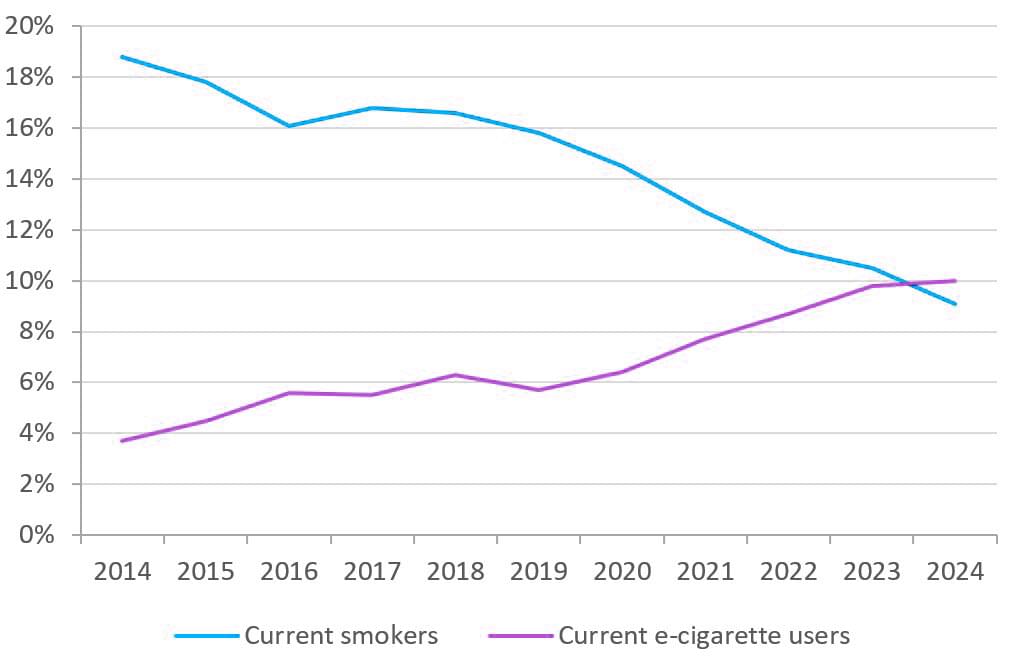
Source: UK Office for National Statistics, Opinion and Lifestyle Survey
Source: Data released
8th November 2025
THR Use in Sweden
Sweden provides a particularly relevant example because snus – a type of reduced-harm oral tobacco – has been used there for decades. Snus and nicotine pouch use has been growing steadily over the long term, while cigarette use has declined.
Smoking & Snus Use in Over-16s, Sweden
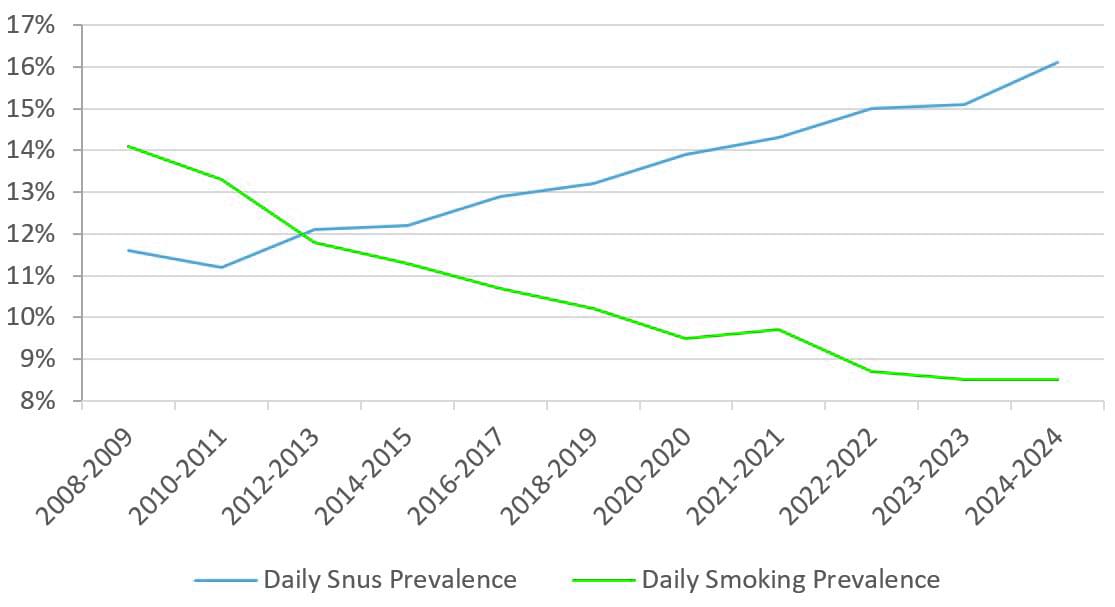
Source: Statistics Sweden
Source: Data released
21st February 2025
THR Use in Japan
Japan was the first market where the introduction of non-combusted tobacco heating products made a large impact, led by the IQOS brand from Philip Morris International. In a short space of time heated tobacco replaced a substantial portion of combustible cigarette volumes, accounting for 38% of the combined market in 2023. By Q3 2025 that share had risen to 46% according to Japan Tobacco.
Cigarette & Heated Tobacco Stick Equivalent Sales, Japan
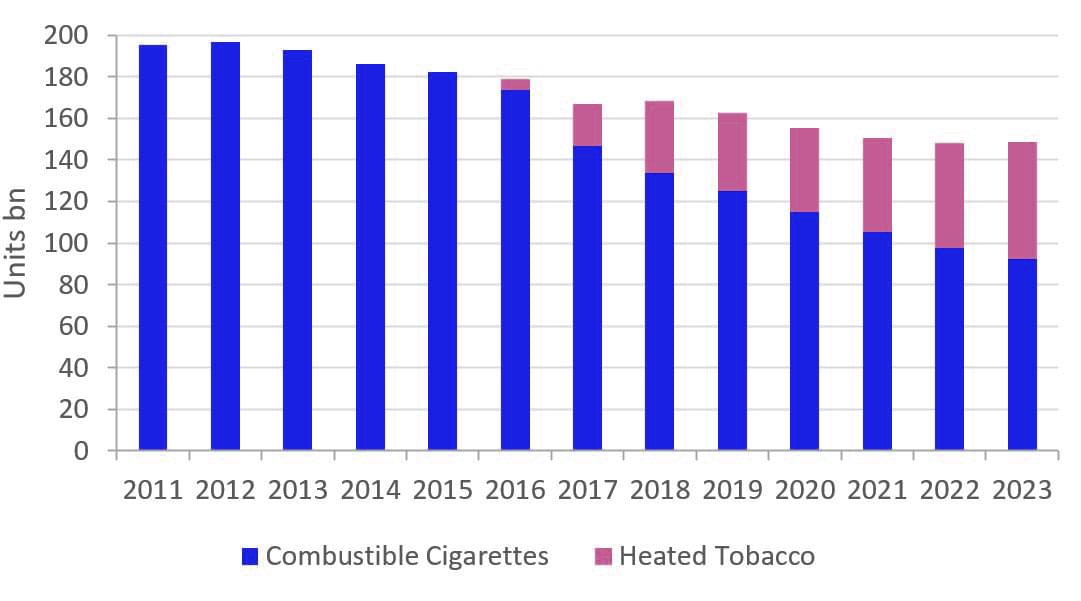
Data from Cummings et al 2024: Transformation of the tobacco product market in Japan, 2011-2023
Further reading:
Transformation of the tobacco product market in Japan, 2011–2023 - Cummings et al, 2024
Next article: The Controversy Surrounding Tobacco Harm Reduction
An investor should consider the investment objectives, risks, and charges and expenses of the fund carefully before investing. A prospectus which contains this and other information about the fund may be obtained by calling 1-800-617-0004, or by clicking here. The prospectus should be read carefully before investing.
Investing involves risk. Principal loss is possible. The Fund is a recently organized entity, giving prospective investors a limited track record on which to base their investment decision. The Fund’s investments will be concentrated in the securities of issuers in the tobacco, or nicotine - related group of industries. The tobacco industry is subject to significant risks and uncertainties that could materially and adversely affect the financial condition and cash flows, of companies operating in it. Investing in foreign securities typically involves more risks than investing in U.S. securities, and includes risks associated with: (i) internal and external political and economic developments – e.g., the political, economic and social policies and structures of some foreign countries may be less stable and more volatile than those in the U.S. or some foreign countries may be subject to trading restrictions or economic sanctions; (ii) trading practices – e.g., government supervision and regulation of foreign securities and currency markets, trading systems and brokers may be less than in the U.S.; (iii) availability of information – e.g., foreign issuers may not be subject to the same disclosure, accounting and financial reporting standards and practices as U.S. issuers; (iv) limited markets – e.g., the securities of certain foreign issuers may be less liquid (harder to sell) and more volatile; and (v) currency exchange rate fluctuations and policies. Investment in emerging market securities involves greater risk than that associated with investment in securities of issuers in developed foreign countries.
Derivatives may pose risks in addition to and greater than those associated with investing directly in securities, currencies or other investments, including risks relating to leverage, imperfect correlations with underlying investments or the Fund’s other portfolio holdings, high price volatility, lack of availability, counterparty credit, liquidity, valuation and legal restrictions. A total return swap is a contract in which one party agrees to make periodic payments to another party based on the change in market value of the assets underlying the contract, which may include a specified security, basket of securities, or securities indices during the specified period, in return for periodic payments based on a fixed or variable interest rate or the total return from other underlying assets. The Fund is a non-diversified, investment company under the 1940 Act. Because the Fund is non-diversified, it will invest a greater percentage of its assets in the securities of a limited number of issuers. Investing in medium and small capitalization companies may involve special risks because those companies may have narrower product lines, more limited financial resources, fewer experienced managers, dependence on a few key employees, and a more limited trading market for their stocks, as compared with larger companies. The securities of micro-cap companies may be more volatile in price, have wider spreads between their bid and ask prices, and have significantly lower trading volumes than the securities of larger capitalization companies.
ETFs are subject to risks that the market price of an ETF's shares may trade at a premium or discount to its net asset value, an active secondary trading market may not develop or be maintained, or trading may be halted by the exchange in which they trade, which may impact an ETF's ability to sell its shares. Shares of any ETF are bought and sold at market price (not NAV) and are not individually redeemed from the ETF. Brokerage commissions will reduce returns
The Hexis Active Nicotine Engagement ETF is distributed by Quasar Distributors, LLC
Definitions used on these pages:
R&D: Research and development spend – investment in developing new products, technologies, or capabilities.
M&A: Mergers and acquisitions spend – spending on acquiring or merging with other companies to expand scale, capabilities, or market access.
Capex: Capital expenditure – investment in long-term physical or intangible assets such as facilities, equipment, or infrastructure.
Discounted Cash Flow (DCF) model – a valuation method that estimates a company’s value by discounting its expected future cash flows back to today.
Terminal value – the estimated value of a business beyond the explicit forecast period in a DCF model.
Terminal growth rate – the assumed long-term, steady growth rate used to calculate terminal value.
EV: Enterprise Value – a measure of a company’s total value, calculated as market capitalisation plus net debt
EBITDA: Earnings before interest, taxes, depreciation and amortisation