Our Engagement Strategy:
Catalyst for Change
At Hexis Capital Management, we believe that for controversial industries in transition, disciplined, active engagement by investors is a more powerful catalyst for change than simple exclusion.
The most common approach to the tobacco sector taken by investors seeking to act responsibly is divestment. But divestment abdicates influence. It leaves a "change engagement vacuum," abandoning companies to passive shareholders who rarely demand structural transformation.
Our philosophy is fundamentally different: we seek to use the power of capital markets to drive change from within. Through the Hexis Active Nicotine Engagement ETF (NICO), we leverage decades of institutional equity research and stewardship expertise to try to accelerate the industry's shift away from combustible tobacco and toward Reduced-Risk Products (RRPs).
We do not practice passive "diligence engagement"; our objective in every meeting, letter, and proxy vote is to persuade our portfolio companies to make specific, measurable changes that accelerate the end of the cigarette era.
The “Virtuous Circle” of Constructive Engagement
True transformation requires transparency. We evaluate companies not just on their successes, but on their willingness to explicitly acknowledge execution risks and roadblocks—whether those are regulatory hurdles, supply chain constraints, or consumer misperceptions.
When a company honestly assesses its challenges, it creates what we call a "Virtuous Circle" of constructive engagement. This transparency allows Hexis, as active owners, to engage directly and productively with management and the board of directors.
Rather than punishing honesty, we collaborate to solve these challenges. This continuous feedback loop of transparency, targeted dialogue, and measurable action should drive sustainable improvement and long-term value creation for both investors and public health.
Our Four Thematic Pillars of Engagement
To ensure our engagement is rigorous and standardized, all Hexis stewardship activities are guided by four factual pillars of transition.
While we expect the leadership of our portfolio companies to demonstrate clear progress across each pillar, we recognize that every company's transition path is unique. Therefore, we customize our engagement objectives, prioritizing the specific actions we believe are most critical to improving each company's Hexis Nicotine Transition Score (HNTS).
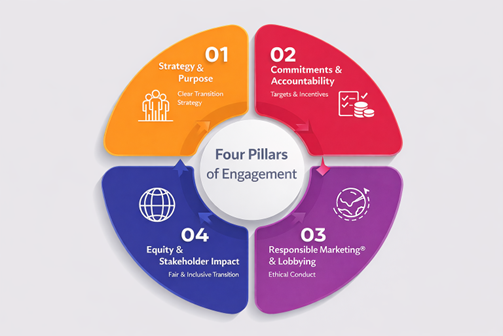
Pillar 1: Strategy & Purpose
A company's transition must be more than a marketing slogan; it must be its core purpose. We expect management and the board of directors to define a clear, public strategy that explicitly prioritizes the transition to reduced-risk products (RRPs).
Furthermore, we ask that the company's capital allocation, R&D spend, and M&A activities are aligned with accelerating this smoke-free purpose into a reality.
Pillar 2: Commitments & Accountability
Credible strategies require binding targets. We seek ambitious targets that increase the proportion of the business accounted for by RRPs.
Crucially, we believe a strategy is only as strong as its incentives. We engage management and the board of directors to ensure that executive compensation and leadership accountability are directly tied to the successful delivery of these harm-reduction milestones, rather than the protection of legacy combustible sales.
Pillar 3: Responsibility in Marketing & Lobbying
As companies transition, their operational conduct must reflect their stated purpose. We advocate for uncompromising policies that prevent youth access to nicotine products.
Additionally, we monitor corporate lobbying to ensure influence does not seek to lock in competitive advantage to the detriment of consumers and overall reduced-harm category growth.
Pillar 4: Equity & Stakeholder Impact
A sustainable transition must be a just transition. We engage companies to ensure that the shift toward RRPs does not exclude or ignore disadvantaged consumers who often have the highest smoking rates.
We also expect companies to protect agricultural and supply-chain workers during this shift, and to ensure that the manufacturing and disposal of new RRP devices minimise environmental harm.
Where Expertise Meets Engagement
Hexis fills the engagement vacuum by transforming the sector’s resilient cash flows into a transparent, accountable transition toward a smoke-free future.
Next article: Harm Reduction Stewardship Council
An investor should consider the investment objectives, risks, and charges and expenses of the fund carefully before investing. A prospectus which contains this and other information about the fund may be obtained by calling 1-800-617-0004, or by clicking here. The prospectus should be read carefully before investing.
Investing involves risk. Principal loss is possible. The Fund is a recently organized entity, giving prospective investors a limited track record on which to base their investment decision. The Fund’s investments will be concentrated in the securities of issuers in the tobacco, or nicotine - related group of industries. The tobacco industry is subject to significant risks and uncertainties that could materially and adversely affect the financial condition and cash flows, of companies operating in it. Investing in foreign securities typically involves more risks than investing in U.S. securities, and includes risks associated with: (i) internal and external political and economic developments – e.g., the political, economic and social policies and structures of some foreign countries may be less stable and more volatile than those in the U.S. or some foreign countries may be subject to trading restrictions or economic sanctions; (ii) trading practices – e.g., government supervision and regulation of foreign securities and currency markets, trading systems and brokers may be less than in the U.S.; (iii) availability of information – e.g., foreign issuers may not be subject to the same disclosure, accounting and financial reporting standards and practices as U.S. issuers; (iv) limited markets – e.g., the securities of certain foreign issuers may be less liquid (harder to sell) and more volatile; and (v) currency exchange rate fluctuations and policies. Investment in emerging market securities involves greater risk than that associated with investment in securities of issuers in developed foreign countries.
Derivatives may pose risks in addition to and greater than those associated with investing directly in securities, currencies or other investments, including risks relating to leverage, imperfect correlations with underlying investments or the Fund’s other portfolio holdings, high price volatility, lack of availability, counterparty credit, liquidity, valuation and legal restrictions. A total return swap is a contract in which one party agrees to make periodic payments to another party based on the change in market value of the assets underlying the contract, which may include a specified security, basket of securities, or securities indices during the specified period, in return for periodic payments based on a fixed or variable interest rate or the total return from other underlying assets. The Fund is a non-diversified, investment company under the 1940 Act. Because the Fund is non-diversified, it will invest a greater percentage of its assets in the securities of a limited number of issuers. Investing in medium and small capitalization companies may involve special risks because those companies may have narrower product lines, more limited financial resources, fewer experienced managers, dependence on a few key employees, and a more limited trading market for their stocks, as compared with larger companies. The securities of micro-cap companies may be more volatile in price, have wider spreads between their bid and ask prices, and have significantly lower trading volumes than the securities of larger capitalization companies.
ETFs are subject to risks that the market price of an ETF's shares may trade at a premium or discount to its net asset value, an active secondary trading market may not develop or be maintained, or trading may be halted by the exchange in which they trade, which may impact an ETF's ability to sell its shares. Shares of any ETF are bought and sold at market price (not NAV) and are not individually redeemed from the ETF. Brokerage commissions will reduce returns
The Hexis Active Nicotine Engagement ETF is distributed by Quasar Distributors, LLC
Definitions used on these pages:
R&D: Research and development spend – investment in developing new products, technologies, or capabilities.
M&A: Mergers and acquisitions spend – spending on acquiring or merging with other companies to expand scale, capabilities, or market access.
Capex: Capital expenditure – investment in long-term physical or intangible assets such as facilities, equipment, or infrastructure.
Discounted Cash Flow (DCF) model – a valuation method that estimates a company’s value by discounting its expected future cash flows back to today.
Terminal value – the estimated value of a business beyond the explicit forecast period in a DCF model.
Terminal growth rate – the assumed long-term, steady growth rate used to calculate terminal value.
EV: Enterprise Value – a measure of a company’s total value, calculated as market capitalisation plus net debt
EBITDA: Earnings before interest, taxes, depreciation and amortisation