Nicotine and Misperceptions
By the 1970s, nicotine’s role in addiction was becoming more widely appreciated — but importantly, nicotine is not what causes most smoking-related diseases.
As the British addiction researcher Michael Russell famously stated: “People smoke for the nicotine, but they die from the tar.”
“Nicotine is not, however, in itself, a highly hazardous drug... It increases hear rate and blood pressure, and has a range of local irritant effects, but is not a carcinogen. Of the three main causes of mortality from smoking, lung cancer arises primarily from direct exposure of the lungs to carcinogens in tobacco smoke, COPD from the irritant and proinflammatory effects of smoke, and cardiovascular disease from the effects of smoke on vascular coagulation and blood vessel walls. None is caued primarily by nicotine.”
Excerpt from Nicotine without smoke: Tobacco harm reduction. Royal College of Physicians, 2016.
Key points:
- Nicotine is a relatively benign stimulant.
- Public perception remains inaccurate: a 2020 survey found 80% of US physicians wrongly believed nicotine directly causes cancer, cardiovascular disease, and COPD.
- The vast majority of the harm from tobacco use comes from inhaling the large number of toxic chemicals produced by combustion.
What Is Tobacco Harm Reduction?
As long as cigarettes remained the products consumed by the vast majority of the world's tobacco users, the debate over whether disease was caused by nicotine or instead by the harmful chemical products of combustion was somewhat academic: nicotine sustained the smoking habit, and smoking killed, so nicotine was seen as harmful.
But over the last decade or so, there has been a growing interest in the potential of tobacco harm reduction (THR). Harm reduction as a concept is rooted in attempts to modify human behaviour to steer people away from the worst risks, for example:
- Providing needle exchanges for people who use drugs
- Offering safe injection sites or opioid substitution treatments
- Making condoms available to those most at risk from HIV or other sexually transmitted infections
As it relates to tobacco, harm reduction is an approach that aims to reduce the health risks faced by people who:
- Don’t want to quit nicotine, or
- Find quitting exceptionally difficult
THR encourages these individuals to switch to substantially less harmful, non-combustible alternatives. It builds on a well-established public-health principle: when eliminating a risky behaviour is difficult, offering safer substitutes can deliver significant improvements in individual and population health.
Building on Michael Russell’s idea that it’s the smoke — rather than the tobacco or nicotine itself — which causes harm, these alternative, non-combustible products carry much lower health risks while still providing both the nicotine and the pleasure that users are seeking.
Tobacco Harm Reduction (THR) Products
Providing nicotine in a clean form was the inspiration behind the first nicotine replacement therapies (NRTs). Starting with nicotine gums and patches in the 1980s and 1990s, NRTs began to be prescribed as a smoking cessation aid by doctors, and then in many countries gained over-the-counter status so that consumers could purchase them without a prescription.
Now a new generation of products is available to consumers which gives then a choice: access to nicotine in a satisfying, much less risky form without having to buy a product – ie NRTs – which is marketed as a ‘medicine’ and something intended to help them quit nicotine altogether.
Amongst the main THR products are

1. Snus and Moist Snuff
Finely ground tobacco placed under the lip, allowing nicotine absorption through the mouth. Snus has been used for over a century in Sweden, Norway and the U.S., and is associated with very low rates of smoking-related disease in Scandinavia.
2. Nicotine Pouches
Similar to snus but contain no tobacco, only nicotine-infused plant fibres. First commercialised around a decade ago, they deliver nicotine orally and have rapidly expanded in Europe and North America.
3. Vapes / E-Cigarettes
Introduced around 20 years ago, these devices heat a liquid to create a nicotine-containing vapour. Evidence indicates they expose users to far fewer toxic substances than cigarettes and can support quitting.
4. Heated Tobacco Products (HTPs)
Heat real tobacco typically to 250–350°C, below the 600–900°C needed for combustion. This releases nicotine and flavour with significantly fewer harmful compounds. Popularised globally in the past decade
What all THR products share:
All THR products, like NRTs, have one thing in common: they do not involve the combustion of tobacco and therefore carry a risk that is orders of magnitude lower than smoking cigarettes.
Relative Risk of 15 Key Tobacco & Nicotine Categories
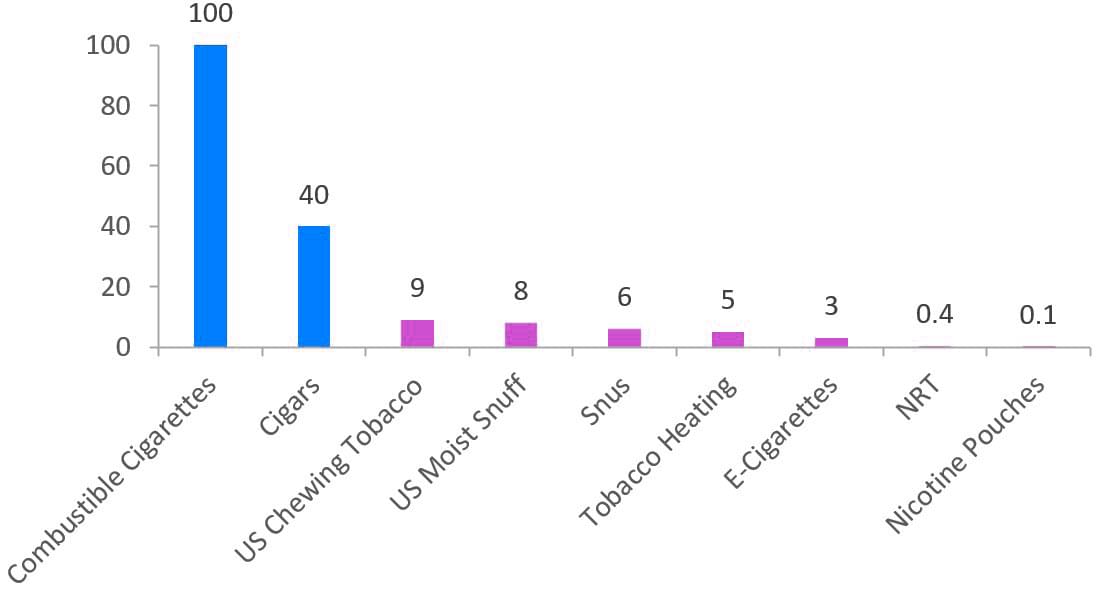
Data from Murket et al, 2022: Nicotine Products relative risk assessment: an updated systematic review and meta-analysis
Future Developments in THR
Significant investment is now being put into the THR category, meaning new products — such as lozenges or sprays — are likely to emerge and gain popularity over time. The boundaries between THR and nicotine replacement therapy (NRT) products may also blur; for example, some vaping products may eventually meet the strict standards required to be prescribed as aids for quitting smoking.
Further reading:
Next article: Evidence of Real-World THR Efficacy
An investor should consider the investment objectives, risks, and charges and expenses of the fund carefully before investing. A prospectus which contains this and other information about the fund may be obtained by calling 1-800-617-0004, or by clicking here. The prospectus should be read carefully before investing.
Investing involves risk. Principal loss is possible. The Fund is a recently organized entity, giving prospective investors a limited track record on which to base their investment decision. The Fund’s investments will be concentrated in the securities of issuers in the tobacco, or nicotine - related group of industries. The tobacco industry is subject to significant risks and uncertainties that could materially and adversely affect the financial condition and cash flows, of companies operating in it. Investing in foreign securities typically involves more risks than investing in U.S. securities, and includes risks associated with: (i) internal and external political and economic developments – e.g., the political, economic and social policies and structures of some foreign countries may be less stable and more volatile than those in the U.S. or some foreign countries may be subject to trading restrictions or economic sanctions; (ii) trading practices – e.g., government supervision and regulation of foreign securities and currency markets, trading systems and brokers may be less than in the U.S.; (iii) availability of information – e.g., foreign issuers may not be subject to the same disclosure, accounting and financial reporting standards and practices as U.S. issuers; (iv) limited markets – e.g., the securities of certain foreign issuers may be less liquid (harder to sell) and more volatile; and (v) currency exchange rate fluctuations and policies. Investment in emerging market securities involves greater risk than that associated with investment in securities of issuers in developed foreign countries.
Derivatives may pose risks in addition to and greater than those associated with investing directly in securities, currencies or other investments, including risks relating to leverage, imperfect correlations with underlying investments or the Fund’s other portfolio holdings, high price volatility, lack of availability, counterparty credit, liquidity, valuation and legal restrictions. A total return swap is a contract in which one party agrees to make periodic payments to another party based on the change in market value of the assets underlying the contract, which may include a specified security, basket of securities, or securities indices during the specified period, in return for periodic payments based on a fixed or variable interest rate or the total return from other underlying assets. The Fund is a non-diversified, investment company under the 1940 Act. Because the Fund is non-diversified, it will invest a greater percentage of its assets in the securities of a limited number of issuers. Investing in medium and small capitalization companies may involve special risks because those companies may have narrower product lines, more limited financial resources, fewer experienced managers, dependence on a few key employees, and a more limited trading market for their stocks, as compared with larger companies. The securities of micro-cap companies may be more volatile in price, have wider spreads between their bid and ask prices, and have significantly lower trading volumes than the securities of larger capitalization companies.
ETFs are subject to risks that the market price of an ETF's shares may trade at a premium or discount to its net asset value, an active secondary trading market may not develop or be maintained, or trading may be halted by the exchange in which they trade, which may impact an ETF's ability to sell its shares. Shares of any ETF are bought and sold at market price (not NAV) and are not individually redeemed from the ETF. Brokerage commissions will reduce returns
The Hexis Active Nicotine Engagement ETF is distributed by Quasar Distributors, LLC
Definitions used on these pages:
R&D: Research and development spend – investment in developing new products, technologies, or capabilities.
M&A: Mergers and acquisitions spend – spending on acquiring or merging with other companies to expand scale, capabilities, or market access.
Capex: Capital expenditure – investment in long-term physical or intangible assets such as facilities, equipment, or infrastructure.
Discounted Cash Flow (DCF) model – a valuation method that estimates a company’s value by discounting its expected future cash flows back to today.
Terminal value – the estimated value of a business beyond the explicit forecast period in a DCF model.
Terminal growth rate – the assumed long-term, steady growth rate used to calculate terminal value.
EV: Enterprise Value – a measure of a company’s total value, calculated as market capitalisation plus net debt
EBITDA: Earnings before interest, taxes, depreciation and amortisation